Term Page
Removal Defense Updates on Prosecutorial Discretion
Removal Defense
This webinar will provide immigration practitioners with an overview of the current prosecutorial discretion landscape after the U.S. Supreme Court’s decision in United States v. Texas, 599 U.S. ___(2023). We will discuss how DHS is applying its...
Challenging a Deficient NTA
Enforcement
Removal Defense
Since the Supreme Court’s decision in Pereira v. Sessions in 2018, there has been a long line of caselaw about whether a Notice to Appear (NTA) missing the time, date or location of proceedings strips the immigration court of jurisdiction to hear a...
This is the second part of a two-part practice advisory on how to effectively challenge an immigration judge's adverse credibility finding with the Board of Immigration Appeals. The two advisories should be read together, as neither part is complete on its own. This second part of the advisory discusses how to challenge adverse credibility findings based on a witness's demeanor or responsiveness; findings that are based on an immigration judge's speculation and conjecture, particularly regarding the plausibility of a claim; and determinations regarding a respondent’s corroborative evidence. It also flags special circumstances to look out for when appealing an immigration judge's adverse credibility finding.
Conviction of “obstruction of justice” is an aggravated felony if a sentence of a year or more is imposed. In Pugin v. Garland, No. 22-23 (June 22, 2023), the Supreme Court overturned the Ninth Circuit’s definition of obstruction, but failed to provide a clear definition of its own. Now some California offenses are likely aggravated felonies if there is a sentence of year or more, including Penal Code §§ 32, 69, 136.1, 148, Vehicle Code § 10851, and others.
This Advisory discusses California offenses under Pugin, and discusses California criminal sentencing dispositions that avoid a sentence of a year or more for immigration purposes.
This Advisory discusses California offenses under Pugin, and discusses California criminal sentencing dispositions that avoid a sentence of a year or more for immigration purposes.
This practice advisory provides an overview of the grounds of inadmissibility for Temporary Protected Status (TPS) explaining which grounds do not apply to TPS applicants, which grounds are non-waivable, and which grounds are waivable. It also offers an overview of the TPS waiver of inadmissibility.
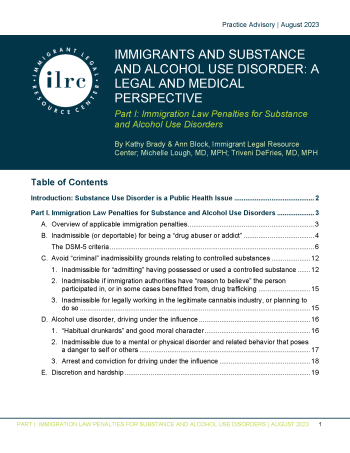
Immigration law demonizes people whom it labels as “drug abusers and addicts,” “habitual drunkards,” and “alcoholics.” The implication is that they are morally weak, dangerous, or evil. An immigrant who comes within such a category can be found inadmissible and ineligible to establish good moral character, and can be denied several forms of immigration relief as well as naturalization. But from a scientific perspective, these people suffer from a substance use disorder (SUD), a medical condition that frequently arises after the person has undergone severe trauma. Substance Use Disorder is a growing health crisis that currently affects over 20 million people in the United States.
This Advisory is written by immigration attorneys and medical doctors specializing in SUD, to examine the issue from both perspectives. Part I of the advisory discusses the several immigration law penalties based on substance use (even when use has not risen to a disorder) and suggests legal defense strategies. Part II of the advisory reviews current medical information about the disorders and discusses how this information can address questions that arise in immigration proceedings.
This Advisory is written by immigration attorneys and medical doctors specializing in SUD, to examine the issue from both perspectives. Part I of the advisory discusses the several immigration law penalties based on substance use (even when use has not risen to a disorder) and suggests legal defense strategies. Part II of the advisory reviews current medical information about the disorders and discusses how this information can address questions that arise in immigration proceedings.
An immigrant legal defense fund pays legal service providers to represent community members facing deportation in immigration court. This resource provides a general overview of immigrant legal defense funds (ILDFs) at the municipal level in Texas, including why they are needed, the goals and components of a strong ILDF, and examples of these funds from across the state.
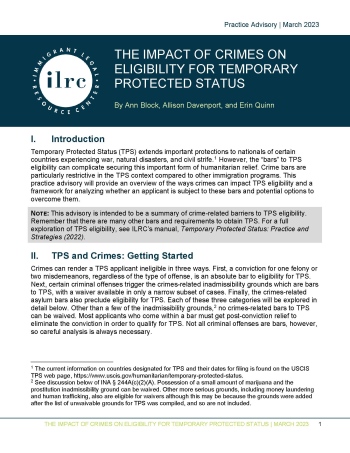
This practice advisory provides an overview of the different ways crimes can impact eligibility for Temporary Protected Status (TPS) and a framework for analyzing whether an applicant is subject to these bars and potential options to overcome them.
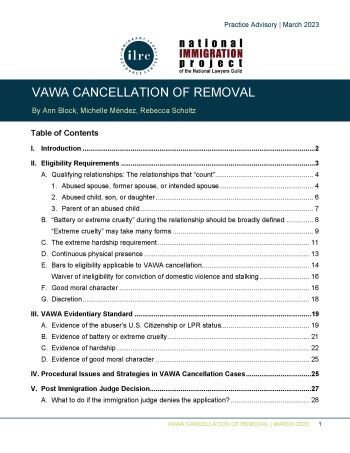
Cancellation of removal under the Violence Against Women Act (“VAWA”) is an often overlooked form of relief for noncitizen survivors of abuse who are faced with removal proceedings. Compared with cancellation of removal for nonpermanent residents (“non-LPR cancellation”), VAWA cancellation is usually a more generous, lenient option for many survivors. In addition, unlike spouse self-petitions, there is no deadline to apply for cancellation after a divorce or loss of immigration status by the abuser, and abused adult sons and daughters are eligible for cancellation without age or marital limitations. This practice advisory introduces and provides an in depth review of each eligibility requirement for VAWA cancellation, discusses the applicable evidentiary standard, and considers procedural issues and strategies useful in immigration court as well as issues arising after an immigration judge issues a decision. Included in this practice advisory is an appendix with a side-by-side comparison of three forms of immigration relief often available to survivors in removal proceedings: VAWA cancellation, VAWA self-petitioning and adjustment of status, and non-LPR cancellation.