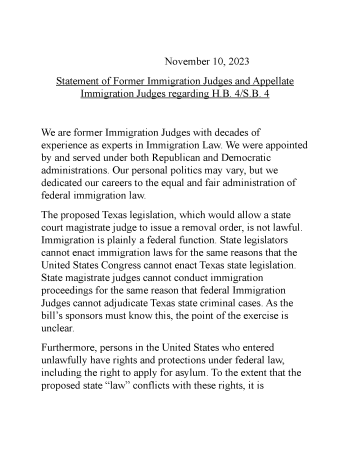
Former Immigration Judges with decades of experience as immigration law experts released this statement, stating that the proposed Texas legislation, HB4 & SB4, which would allow a state court magistrate judge to issue a removal order is not lawful.
This is ILRC’s comment on the proposed EOIR rule (the rescission of what we referred to as Trump’s “Death to Due Process Rule”). The Trump rule attempted to change case briefing schedules, case timelines, judges’ control over cases, etc. – all in ways that would make it even harder for folks in immigration court to obtain immigration relief. ILRC has engaged in substantial advocacy to get rid of this rule, including being a plaintiff in the case challenging this Trump rule
AILA, ILRC, CAST, Lucas & Barba LLP, Urban Justice Center, Her Justice, and ASISTA coordinated a stakeholder meeting on May 8, 2023. These unofficial notes capture the questions asked and general information shared by USCIS staff.
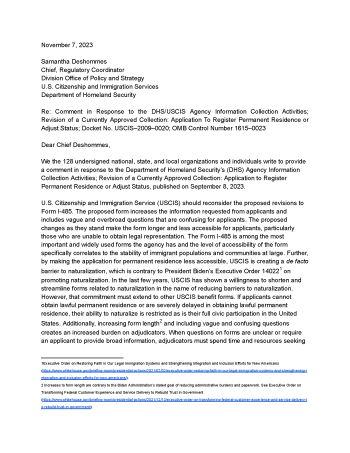
ILRC led a sign-on effort to provide comment to USCIS on the proposed changes to Form I-485, Application to Register Permanent Residence or Adjust Status. The comment, submitted November 7, 2023, received over 120 signatures and requested that the agency revise the form for efficiency and to remove barriers to eligible applicants.
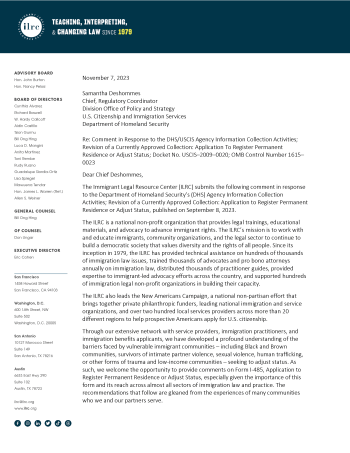
On November 7, 2023, the ILRC submitted this comment on USCIS’s proposed changes to Form I-485, Application to Register Permanent Residence or Adjust Status. The comment provides detailed suggestions for alterations to the proposed form as well as suggested language the agency should include. ILRC urged the agency to revise the form to reduce barriers to permanent residence for applicants and adjudicators and to focus on ensuring that the form is accessible for pro se applicants.
The U Visa: Obtaining Status for Immigrant Survivors of Crime will guide you through the entire process of handling an immigration case—from U visa eligibility screening for U nonimmigrant status, to communicating about the waitlist, bona fide determination, and deferred action, to adjustment of status, to assisting eligible family members, and to helping U nonimmigrants travel. In addition to providing a thorough explanation of the U visa requirements and U Visa application processes, this manual includes numerous practice pointers and sample materials to help you in handling your client’s case.
All About U Derivatives
U Visa/T Visa/VAWA
This webinar will cover the different ways that U petitioners can include derivatives, including at the time of filing the principal application, after the principal application has been filed, and after the principal application has been approved...
Introduction to TPS
Temporary Protected Status
Temporary Protected Status (TPS) is an important form of humanitarian relief for people from certain designated countries that have experienced armed conflict, natural disaster, or other conditions that prevent nationals from returning safely. There...
CSPA: Understanding the Child Status Protection Act
Family-Based
Immigrant Youth
We will review how the CSPA protects certain family-based beneficiaries of immigrant visa petitions and how to calculate the CSPA age. We will also review when the Visa Bulletin is involved, and when and how visa regression affects the CSPA age...