Recently, USCIS has conflated guidance for naturalization disability waivers of English and civics with waivers of the oath requirement for persons with disabilities. The confusion stems from USCIS’s addition of a question on oath waivers on the N-648 disability waiver form. These are separate waivers with distinct purposes, legislative histories, and administrative guidance.
This practice advisory will describe the enactment of the oath waiver and current USCIS guidance as well as describe the ways that it is distinct from a waiver of the English/civics requirement.
This practice advisory will describe the enactment of the oath waiver and current USCIS guidance as well as describe the ways that it is distinct from a waiver of the English/civics requirement.

Law enforcement agencies in California have been responding to requests for U visa certifications for many years to allow immigrant survivors of crime and their family members to apply for U nonimmigrant status. However, until 2016 there was no statewide standard or protocol for certifications. Several bills have passed in the meantime to further streamline the process. Most recently, AB 1261 was signed into law in October 2023 and went into effect on 01/01/2024. The Immigrant Legal Resource Center and the Los Angeles Center for Law and Justice wrote this advisory to summarize California state laws on U visa certifications, including the newest provisions.
Texas-based organizations comprised of, representing, and serving individuals and communities directly impacted by border enforcement measures write to Texas Members of Congress to seek solidarity and to implore not to worsen the crisis by layering over sweeping new federal border and asylum restrictions. The organizational letter highlights how these changes would have disastrous consequences not only for migrants but for Texas communities, who are presently living under the oppressive and unconstitutional Operation Lone Star.
Criminal Convictions can have serious consequences on peoples’ lives – especially non-citizens who wish to stay in the United States. Many immigration benefits have criminal bars, meaning that certain convictions will prevent you from getting a lawful immigration status, like permanent residence (green card). This Community Explainer offers some options for those who have had certain convictions related to domestic violence or human trafficking, with insights about how to define these crimes, some example scenarios, and explanations about the benefits of a legal tool called a “vacatur.”
This downloadable flyer is designed to raise awareness about the misinformation that often circulates in the undocumented community about the viability of qualifying for lawful permanent resident status solely for having lived in the U.S. for at least 10 years.
If you are hoping to attain lawful permanent resident status (getting a green card) or apply for an immigrant visa as a “child” and your 21st birthday is coming up, read this Community Alert to learn about how changes to USCIS’ interpretation of a law called the Child Status Protection Act might impact you.
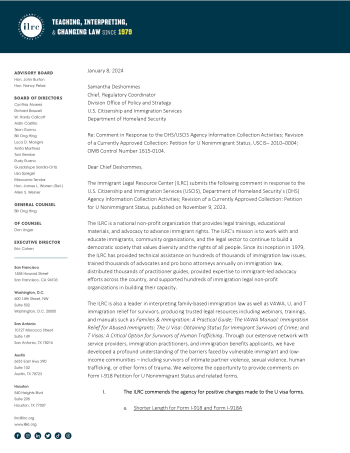
ILRC submitted this comment on the many proposed changes to U Visa Forms I-918, I-918A, and I-918B. ILRC commended the agency for many changes, including shortening Forms I-918 and I-918A and removing many questions about rare grounds of inadmissibility. ILRC also provided suggestions for how the agency could further streamline Forms I-918 and I-918A, and raised concerns about the expansion of Form I-918B.