Term Page
Policy Advocacy 
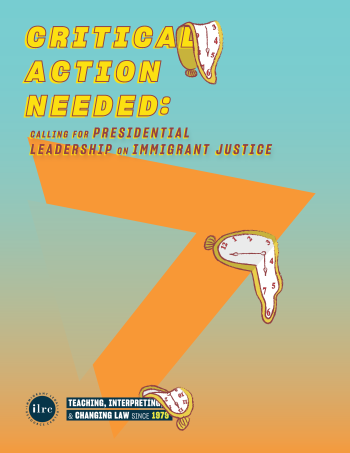
Throughout the Biden administration the Immigrant Legal Resource Center (ILRC) has called on the President to both restore the systems that offered protection and access to immigration benefits decimated during the Trump years and steer us on a new path toward dignity and justice. This proposal highlights the critical actions immigrant communities need before this administration ends include ensuring immigration benefits are equitable and accessible for low-income immigrants of color and ending immigration arrests, immigration detention, and deportations.
Throughout the Biden administration the Immigrant Legal Resource Center (ILRC) has called on the President to both restore the systems that offered protection and access to immigration benefits decimated during the Trump years and steer us on a new path toward dignity and justice. This proposal highlights the critical actions immigrant communities need before this administration ends include ensuring immigration benefits are equitable and accessible for low-income immigrants of color and ending immigration arrests, immigration detention, and deportations.
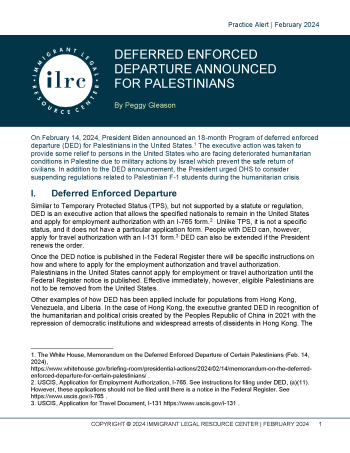
On February 14, 2024, President Biden announced an 18-month Program of deferred enforced departure (DED) for Palestinians in the United States. This alert describes the content of the executive order. Eligible persons may apply for employment and travel authorization under the program when a notice is published in the Federal Register.
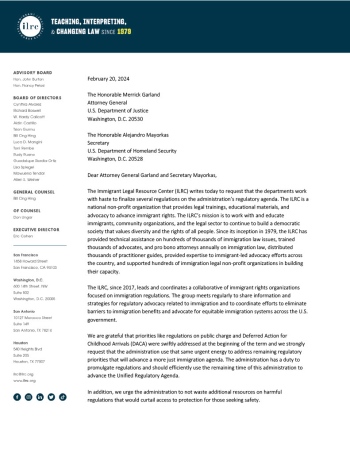
On Feb. 20, 2024, the ILRC sent a letter to DHS Secretary Alejandro Mayorkas and Attorney General Merrick Garland urging the release of regulations in 2024. The purpose of the letter is to encourage the Biden Administration to publish regulations regardless of the political concerns of the upcoming election year. The ILRC focused on the release of some proposed regulations that have been scheduled for publication, and also urged the administration to rescind and replace asylum regulations leftover from the previous administration, and also to refrain from publishing additional regulations that restrict asylum at the southern border.
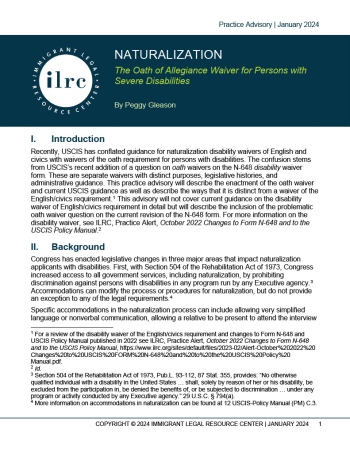
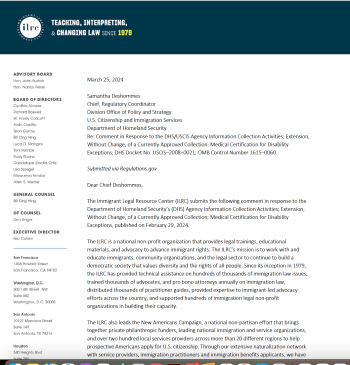
Recently, USCIS has conflated guidance for naturalization disability waivers of English and civics with waivers of the oath requirement for persons with disabilities. The confusion stems from USCIS’s addition of a question on oath waivers on the N-648 disability waiver form. These are separate waivers with distinct purposes, legislative histories, and administrative guidance.
This practice advisory will describe the enactment of the oath waiver and current USCIS guidance as well as describe the ways that it is distinct from a waiver of the English/civics requirement.
This practice advisory will describe the enactment of the oath waiver and current USCIS guidance as well as describe the ways that it is distinct from a waiver of the English/civics requirement.
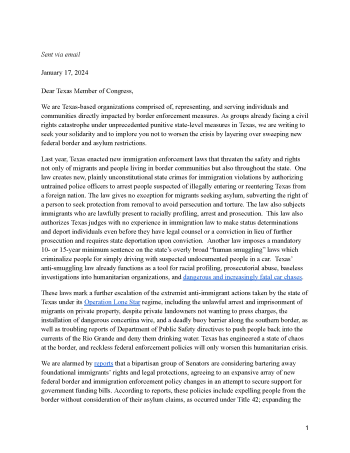
Texas-based organizations comprised of, representing, and serving individuals and communities directly impacted by border enforcement measures write to Texas Members of Congress to seek solidarity and to implore not to worsen the crisis by layering over sweeping new federal border and asylum restrictions. The organizational letter highlights how these changes would have disastrous consequences not only for migrants but for Texas communities, who are presently living under the oppressive and unconstitutional Operation Lone Star.
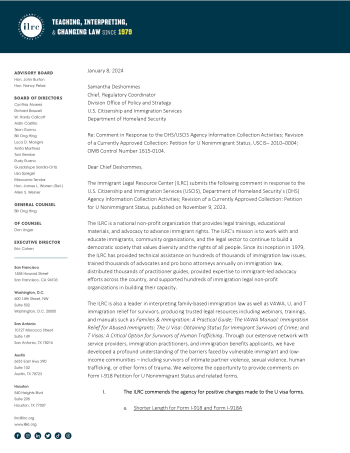
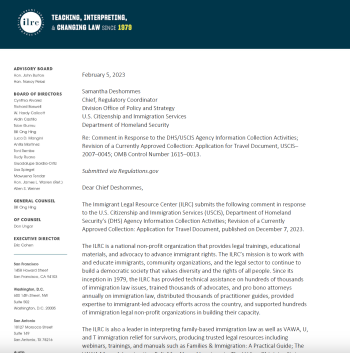
ILRC submitted this comment on the many proposed changes to U Visa Forms I-918, I-918A, and I-918B. ILRC commended the agency for many changes, including shortening Forms I-918 and I-918A and removing many questions about rare grounds of inadmissibility. ILRC also provided suggestions for how the agency could further streamline Forms I-918 and I-918A, and raised concerns about the expansion of Form I-918B.