This downloadable community explainer provides an overview of the current state of DACA, where the program stands given the uncertainty of pending federal litigation, and what beneficiaries should be considering as we wait for a court decision on the program’s future.
California immigrants who file taxes may now receive cash from the California Earned Income Tax Credit (CalEITC). As the negative effects of COVID-19 continue impacting immigrant families, many are in need of support. Filing taxes may mean cash benefits for qualifying families. This guide provides a brief summary of what CalEITC is and who can benefit from it.
This resource provides an overview of the process of traveling on advance parole and returning to the United States through a port of entry. For those granted permission to travel on advance parole, the return process can be intimidating and confusing. We’ve outlined ways to prepare for travel under Advance Parole and tips to make the process as smooth as possible.
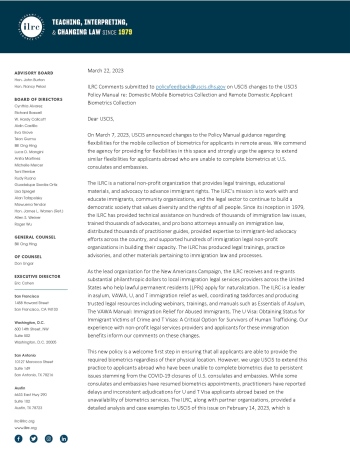
On March 22, 2023, the ILRC sent a letter to USCIS acknowledging the implementation of biometrics flexibilities for domestic benefits applicants who live in remote areas. The ILRC commended the agency on its provision of flexibilities to ensure that all domestic applicants could continue with their benefits applications regardless of physical location in the United States. The ILRC further urged USCIS to expand these flexibilities to applicants abroad and highlighted the negative effects that consulate closures abroad have had on U and T visa applicants attempting to complete their biometrics abroad.
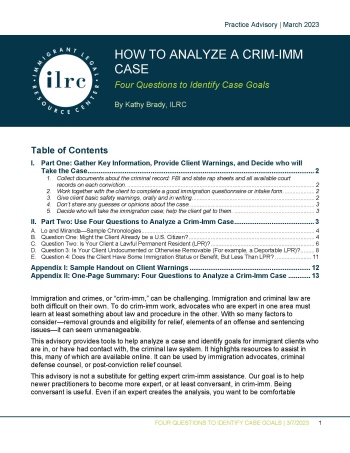
Immigration and crimes, or “crim-imm,” can be challenging. Both immigration and criminal law are difficult on their own. To do crim-imm work, advocates who are expert in one area must learn at least something about law and procedure in the other. It can be hard to know where to start the analysis.
This advisory provides a step-by-step approach to help advocates analyze a case and identify goals. It can be used by criminal defense counsel, immigration advocates, and post-conviction relief counsel. It is not a substitute for consulting with a crim/imm expert, but using it should increase your expertise and help you to better discuss the analysis with the client, argue it to the judge or official, or negotiate with the other side.
This advisory provides a step-by-step approach to help advocates analyze a case and identify goals. It can be used by criminal defense counsel, immigration advocates, and post-conviction relief counsel. It is not a substitute for consulting with a crim/imm expert, but using it should increase your expertise and help you to better discuss the analysis with the client, argue it to the judge or official, or negotiate with the other side.
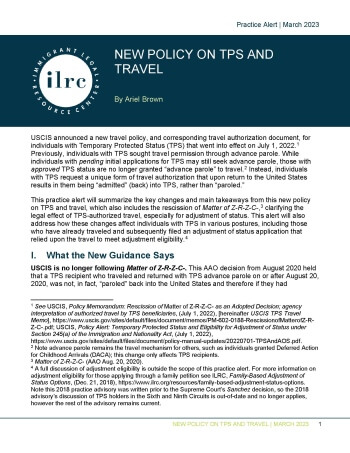
This practice alert provides an overview of USCIS’s new policy on TPS travel, including a new travel document specific to TPS holders that replaces advance parole, rescission of Matter of Z-R-Z-C-, and clarification of the legal effect of TPS-authorized travel, especially for adjustment of status.
This guide provides a walkthrough of how individuals can submit a public comment whenever the federal government publishes a proposed rule that creates or changes existing policy. Many published rules, such as proposed changes to public charge or increases in USCIS filing fees, have an impact on immigration processes so it is vital for the public to share their feedback if they find they would be impacted if the proposed rules become law.
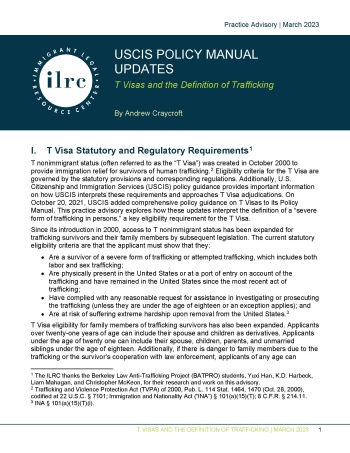
U.S. Citizenship and Immigration Services (USCIS) policy guidance provides important information on how USCIS interprets these requirements and approaches T Visa adjudications. On October 20, 2021, USCIS added comprehensive policy guidance on T Visas to its Policy Manual. This practice advisory explores how these updates interpret the definition of a “severe form of trafficking in persons,” a key eligibility requirement for the T Visa.
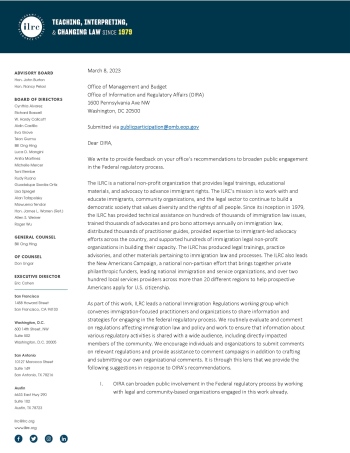
On March 8, ILRC responded to a request for input from the Office of Information and Regulatory Affairs (OIRA) on how to broaden public engagement with the public in the federal regulatory process. ILRC suggested that OIRA partner with community organizations to ensure that information is shared in the most effective way possible, including written materials and trainings. ILRC also made several process suggestions that OIRA can implement to reduce barriers to public participation.
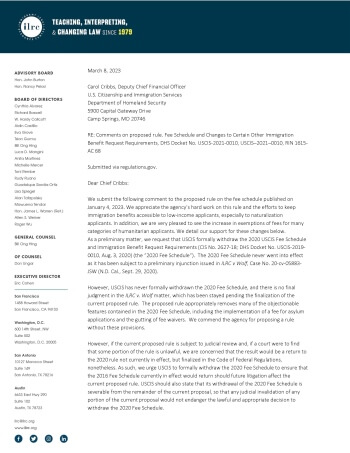
On March 8, ILRC provided comments on the USCIS proposed fee rule. In the comment, ILRC commended agency actions codifying fee exemptions. Additionally, ILRC requested that USCIS codify fee waiver eligibility standards and raise the income threshold for fee waivers. We also requested that fee increases be reduced for applications for lawful permanent residence, work authorization and family petitions, among others. Finally, the comment provides requested changes to various USCIS forms that are open for comment in conjunction with the proposed fee rule.