Immigrant Youth

Term Page
Immigrant Youth
In this resource – updated to reflect significant changes to the Visa Bulletin that will impact special immigrant juveniles beginning in April 2023 – we discuss the visa backlog for youth applying for a green card through special immigrant juvenile status (SIJS). We discuss how to determine when your client may apply for a green card and provide practice tips for representing youth seeking SIJS who may face a long wait before they are able to get a green card.

Crafting a Successful SIJS State Court Predicate Order

Immigrant Youth

Level: Intermediate Eligibility for special immigrant juvenile status (SIJS) requires the involvement of a state juvenile court. This webinar will go over what needs to be included in a successful SIJS state court predicate order, looking at guidance...
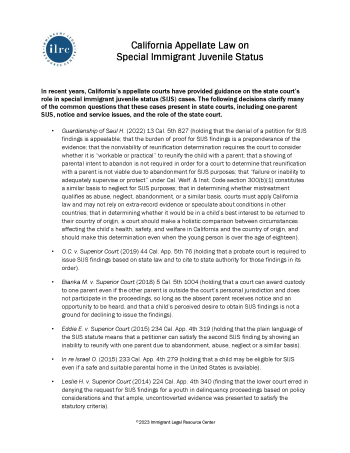
In recent years, California’s appellate courts have provided guidance on the state court’s role in Special Immigrant Juvenile Status (SIJS) cases. The following decisions clarify many of the common questions that these cases present in state courts, including one-parent SIJS, notice and service issues, and the role of the state court
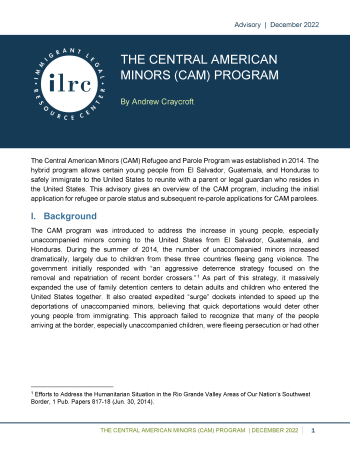
The Central American Minors program (CAM) is a hybrid refugee and parole program. It benefits minors in El Salvador, Guatemala, and Honduras who have a parent or legal guardian living in the United States under certain forms of immigration status. The program was first introduced in 2014, but was terminated in 2017 under the Trump administration. The Biden administration reinstated the program in 2021 and added new eligibility criteria. This advisory gives an overview of the CAM program including its refugee and parole components, as well as subsequent re-parole applications for existing parolees who wish to maintain their status. Although only a designated refugee resettlement agency may file an initial CAM application, other practitioners play an important role in screening for possible CAM eligibility to make referrals to designated agencies and in assisting current CAM parolees.

Immigrant Youth

The Immigrant Legal Resource Center (ILRC) is one of only a few technical assistance organizations nationally and in California with expertise on immigrant youth, including unaccompanied minor (UAC) issues. Undocumented immigrant children are an extremely vulnerable population, especially when they enter foster care, removal proceedings, and/or the juvenile justice system. The ILRC works to expand the rights of these immigrant children through policy and advocacy efforts, numerous in-person and webinar trainings, and case-specific assistance. We also write one of the only national publications addressing immigrant youth issues entitled, Special Immigrant Juvenile Status and Other Immigration Options for Children & Youth.

Many immigrant youth in the United States may be eligible to apply for lawful immigration status. One of the most common immigration options for immigrant youth is special immigrant juvenile status (SIJS), which is a pathway to a green card for immigrant children who have been abused, abandoned, or neglected by one or both of their parents. Other common forms of relief for children include U visas (for children who were victims of crimes), relief under the Violence Against Women Act (for children who were abused by a U.S. citizen or permanent resident parent or spouse), and asylum (for children who are afraid of returning to their home country).

Latest Resources

Practice Advisory
Resources
Publication Date
11/21/2025
This resource – created with our partners at the Children’s Immigration Law Academy and National Immigration Project – answers common questions about expedited removal and its application to children and offers arguments against its application to young people who were processed as UCs and young people with approved special immigrant juvenile status (SIJS), should the government attempt to apply it to those groups.
Practice Advisory
Resources
Publication Date
09/18/2025
This practice advisory provides information about recently implemented fee increases at USCIS and EOIR. These fee increases are a result of the “One Big Beautiful Bill Act” also known as HR1. This advisory explores what we know and what we still don’t know about the fees, how to pay them, and potential future changes.
Toolkit & Reports
Resources
Publication Date
09/04/2025
On April 15, 2025, the ILRC filed a Freedom of Information Act (FOIA) request for USCIS records regarding the SIJS Deferred Action Policy. When the government failed to respond in a timely manner, we filed suit. This resource includes all documents we have received from USCIS as a result of the FOIA request, as well as a short summary of the request and results.
Public Comments / Sign-on Letters
Resources
Publication Date
07/24/2025
On July 24, 2025, the ILRC submitted a comment strongly opposing the government’s proposed changes to Form G-325A and related policies that end protections for three vulnerable groups: young people with Special Immigrant Juvenile Status (SIJS), stateless individuals, and immigrant workers in the Deferred Action for Labor Enforcement (DALE) program.
Public Comments / Sign-on Letters
Resources
Publication Date
07/28/2025
The ILRC strongly opposes new U.S. Citizenship and Immigration Services (USCIS) policy changes that end deferred action for youth approved for Special Immigrant Juvenile Status (SIJS).
Public Comments / Sign-on Letters
Resources
Publication Date
07/16/2025
On July 16, 2025, ILRC submitted a comment opposing a new U.S. Citizenship and Immigration Services (USCIS) policy that allows the agency to use “derogatory information” against immigration applicants without always disclosing it.
Public Comments / Sign-on Letters
Resources
Publication Date
07/07/2025
On July 7, 2025, the ILRC submitted a comment opposing a new federal rule that changes how the Office of Refugee Resettlement (ORR) handles unaccompanied children.
FAQs & Explainers
Resources
Publication Date
07/16/2025
Community members across the country are reporting visits from immigration and other federal officers seeking to meet with certain children who entered the United States unaccompanied. These children are often referred to as “unaccompanied children” (UCs) because at the time they were arrested by immigration (such as crossing the border), they were not with a parent or legal guardian. Although these visits are sometimes described as “wellness checks,” they are part of a broader, coordinated effort to locate and deport some vulnerable young people and their sponsors. It is crucial for families and immigrant communities to stay informed, exercise their rights, and seek legal support when needed.
Practice Advisory
Resources
Publication Date
07/01/2025
In recent months, the Department of Homeland Security has begun filing thousands of motions to recalendar administratively closed proceedings. This trend is raising questions about how attorneys and accredited representatives can respond to these motions and protect their clients’ interests, particularly in cases that have been administratively closed for many years. This advisory explores those questions and offers strategy considerations when determining how to proceed in each case.
Practice Advisory
Resources
Publication Date
04/17/2025
The Trafficking Victims Protection Reauthorization Act of 2008 confers initial jurisdiction over asylum claims filed by unaccompanied children (UCs) to the asylum office. The Board of Immigration Appeals’ decision in Matter of M-A-C-O-, along with policy changes implemented during the first Trump administration, sought to strip away this crucial protection from many child asylum seekers. Because of these changes and legal challenges by immigrant youth advocates, the current landscape of initial UC asylum jurisdiction has changed. This practice advisory provides an overview of the current state of UC asylum jurisdiction following the Matter of M-A-C-O- decision and the outcome of the JOP v. DHS litigation. It also offers some arguments and practical tips to help practitioners advocate for their UC clients to receive the statutory protections afforded by the TVPRA, as well as the benefits from the JOP v. DHS litigation.

Special Immigrant Juvenile Status

Immigrant Youth

Special Immigrant Juvenile Status and Other Immigration Options for Children and Youth is an essential guide for those representing the increased number of unaccompanied minors who have migrated to the United States in recent years, as well as those...