Term Page
DACA 
On January 1, 2021, multiple California criminal reform laws took effect. These laws were passed to help all defendants regardless of immigration status, but they can be of special help to noncitizens. Advocates should understand how these laws may help a client’s immigration case. They include:
In this practice advisory co-drafted with Public Counsel, we answer common questions on how to tackle disclosure of juvenile adjudications and dissemination of court records for individuals interested in applying for DACA. It also includes a sample DACA request packet, which shows various ways to disclose juvenile adjudications and comply with state confidentiality laws.

Applicants must meet certain requirements to be eligible for DACA, including showing that they have been continuously residing in the United States since June 15, 2007. Acquiring documents to use as evidence to prove the continuous residence requirement can be tedious. As such, this resource focuses on the types of evidence initial DACA applicants can gather to prove continuous residence and where applicants can get this evidence.
Persons are barred from receiving or renewing DACA if they have been convicted of a felony, a significant misdemeanor, three or more misdemeanors, or otherwise pose a threat to national security or public safety. DACA applicants who have been arrested or convicted of a crime may still be eligible, but they should first obtain their criminal records and take them to an expert immigration practitioner to obtain legal advice about their eligibility and potential risks of applying. This resource provides persons applying for DACA with instructions about what criminal records they need for their application and how they can find them.
This practice advisory reviews the general eligibility requirements for DACA, as well as issues advocates should look out for when determining eligibility. There has been a lot of interest from community members and advocates in the DACA program since the program was reinstated by a federal court for DACA initial applications in November of 2020. This advisory offers information to guide advocates as they determine eligibility.
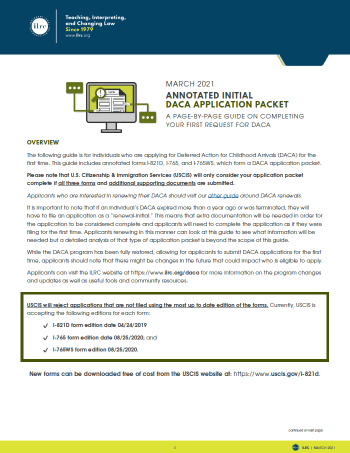
The ILRC’s DACA Team has put together a page-by-page form guide for anyone looking to apply for Deferred Action for Childhood Arrivals (DACA) as an initial request. This annotated community resource provides insights into many of the questions asked of recipients when completing the forms needed to make up a complete application packet (forms I-821D, I-765, and I-765WS). As stated in the document, it is important that any individual completing their forms ensures that they are using the most up-to-date forms USCIS offers – otherwise they will reject your submission.
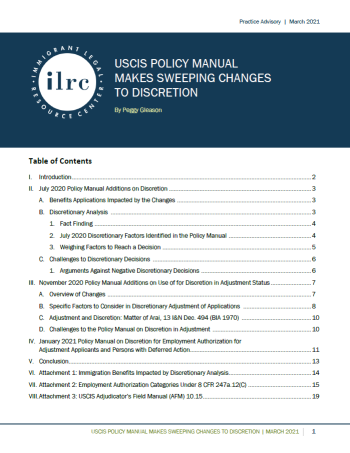
In 2020 and 2021, USCIS changed its interpretation of discretion in adjudication of immigration benefits in three separate releases of policy manual guidance.[i] These chapters add voluminous positive and negative discretionary factors that adjudicators are instructed to analyze in more than a dozen types of immigration benefits, including many categories of employment authorization, adjustment to permanent residence, temporary protected status and change of status applications.

With USCIS now accepting requests for DACA from individuals who have never had DACA, it's VITAL that we understand how to put our best foot forward when compiling evidence documents and application forms. In this video Staff Attorney Veronica Garcia and Legal Outreach Coordinator Abraham Bedoy walk through everything you need to know to prepare to submit your initial application packet!
Certain criminal convictions are bars to eligibility for DACA. However, if these convictions can be “expunged,” they will cease to be an absolute bar. Here, an “expungement” refers to any legal process where a criminal court can withdraw, erase, seal, or otherwise eliminate a conviction under a state statute, based on the fact that the person completed probation or other requirements, or for humanitarian reasons. Note that while DACA government materials call this an “expungement,” different state laws may use different terms for this kind of rehabilitative relief. An expungement is not given effect for most immigration purposes – but it does work for DACA. For example, a misdemeanor conviction for driving under the influence is a bar to applying for DACA as a “significant misdemeanor.” If the person has the conviction “expunged,” however, they are not barred from applying, and if they have enough positive equities they may well be granted DACA.