Term Page
DACA 
This advisory provides practitioners with current information about the public charge ground of inadmissibility, including addressing what is public charge, who does it apply to, how is public charge evaluated, and could being a public charge make someone deportable.

Currently, individuals who have Deferred Action for Childhood Arrivals (DACA) can request and travel with Advance Parole. DACA recipients can request Advance Parole for humanitarian, employment, and education reasons. To qualify, DACA recipients will need to demonstrate that their need to travel falls within one of these categories. This community resource provides an overview of travel with Advance Parole and gives some examples of what may qualify.

On November 18, 2021, the ILRC submitted comments making recommendations to USCIS regarding the agency’s proposed regulation on the Deferred Action for Childhood Arrivals (DACA) program. ILRC focused on recommendations that address the need for USCIS to create standards within this regulation to ensure equitable and consistent treatment for DACA applicants.
On September 28, 2021, DHS issued a notice of proposed rulemaking for Deferred Action for Childhood Arrivals. The proposed rule seeks to codify DACA and while this presents real opportunities, there are serious problems with the rule in regard to the criminal bars to DACA, in particular the elimination of expungements for DACA purposes. See proposed rule here.
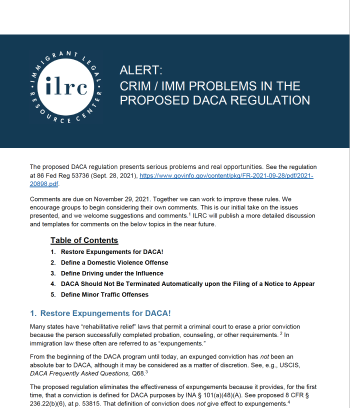
The proposed DACA regulation presents serious problems and real opportunities. See the regulation at 86 Fed Reg 53736 (Sept. 28, 2021), https://www.govinfo.gov/content/pkg/FR-2021-09-28/pdf/2021-20898.pdf.
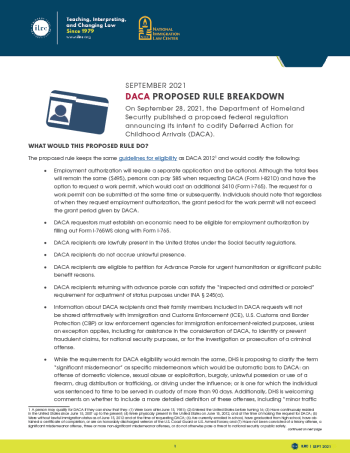
On September 28, 2021, the Department of Homeland Security published a proposed federal regulation announcing its intent to codify Deferred Action for Childhood Arrivals (DACA).
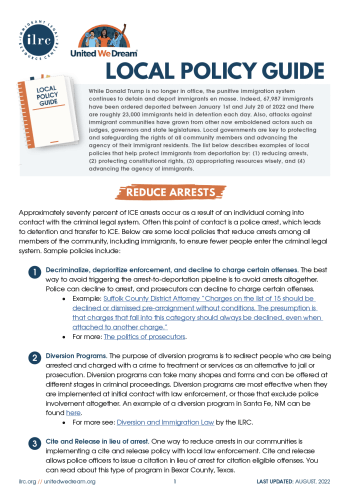
As attacks on immigrants continue and the DACA program remains in limbo, now more than ever, it is important that local elected officials take bold action to protect immigrants within their jurisdictions. This guide, co-authored by United We Dream, provides examples of local policies that help protect immigrants from deportation by: (1) reducing arrests, (2) protecting constitutional rights, and (3) appropriating local resources wisely.
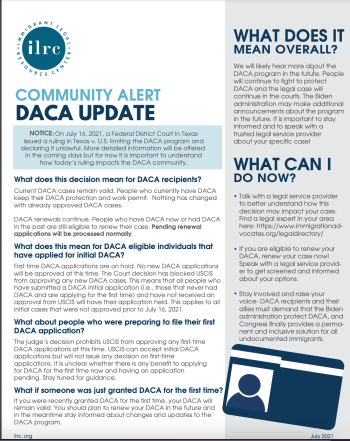
On July 16, 2021, a Federal District Court in Texas issued a ruling in Texas v. United States limiting the DACA policy and declaring it unlawful. More detailed information on this decision will be offered in the coming days but for now it is important to understand how today’s ruling impacts the DACA community.
While the immigration field has long explored how to provide legal services to underserved communities, determining how to deliver high quality services remotely became a universal concern during the COVID-19 pandemic. Now, as organizations gradually return to in-person services, some are exploring how to integrate remote practices into this changed landscape. In this practice advisory, we review the ongoing impact of the pandemic on immigrant communities, U.S. Citizenship and Immigration Services (USCIS), and immigration legal service agencies. We also provide lessons learned from agencies across the country that are continuing to think expansively about how to incorporate remote services to meet clients’ needs.
Children and youth compose a significant portion of the U.S. immigrant population and often qualify for various forms of immigration relief, many of which involve an application filing fee. Under the Trump administration, USCIS promulgated a final rule intended to dramatically raise fees for many immigration application forms, including those available to young people, and would have limited access to fee waivers. The rule was blocked by federal courts, and after President Biden took office, the Department of Justice decided not to defend the rule, so it never took effect and for now immigration filing fees remain at the previously set amounts. This advisory reviews some of the main forms of immigration relief available to children and youth and the current fees for each, and summarizes the litigation and related efforts that ultimately defeated the Trump fee rule.