Term Page
DACA
In light of the continued failure of the U.S. Congress to pass meaningful immigration reform and the continued dysfunction of our immigration system, President Obama announced a series of immigration policy changes though executive action during his presidency. This manual discusses the law, policy, and practice regarding the parts of President Obama’s executive action that have been implemented as of the time of this writing. These new changes, even if short-lived, can help many. They can provide individuals with much-needed immigration relief, and also provide a blueprint for future immigration policy and legislation. Many programs mentioned in this manual, such as parole, DACA, and the enforcement priorities, are in flux, particularly after the 2016 election. We therefore invite you to visit the Immigrant Legal Resource Center’s website at www.ilrc.org for updates and to join our education listserv by subscribing at www.ilrc.org/subscribe to receive email messages about updates to this manual as well as in-person and webinar trainings opportunities related to immigration executive actions.
This video details how to complete a DACA renewal application packet by walking through the various forms’ questions to highlight what they mean and focus on areas worth paying close attention to. As always, we highly encourage applicants to seek a consultation with a trusted legal service provider before submitting their packets. Namely this is so applicants can ensure they are submitting their information as accurately as possible and addressing the dimensions of their specific case that may or may not allow them to be eligible for other forms of immigration relief. In this one-hour walkthrough video, the ILRC’s Legal Outreach Coordinator, Abraham Bedoy, dives deep into each form required for a renewal so those taking on their own application packet (forms: I-821D, I-765, I-765WS, G-1145) can follow along to double-check their entries.
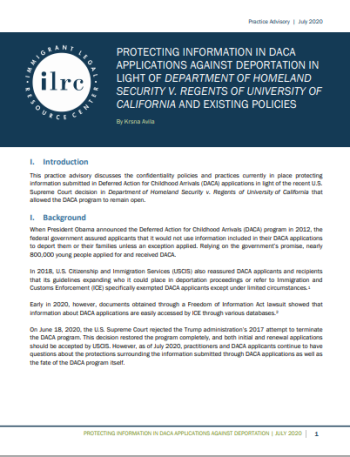
This practice advisory discusses the confidentiality policies and practices currently in place protecting information submitted in Deferred Action for Childhood Arrivals (DACA) applications in light of the recent U.S. Supreme Court decision in Department of Homeland Security v. Regents of University of California that allowed the DACA program to remain open.
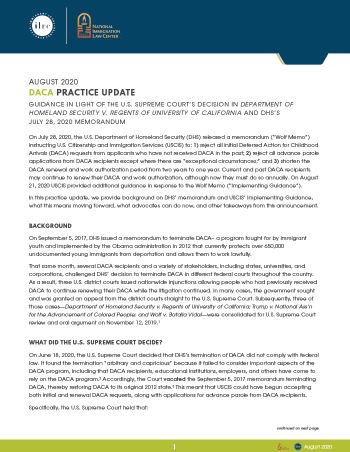
On July 28, 2020, the U.S. Department of Homeland Security (DHS) released a memorandum instructing U.S. Citizenship and Immigration Services (USCIS) to: 1) reject all initial Deferred Action for Childhood Arrivals (DACA) requests from applicants who have not received DACA in the past; 2) reject all advance parole applications from DACA recipients except where there are “exceptional circumstances;” and 3) shorten the DACA renewal and work authorization period from two years to one year. This Memorandum was followed by USCIS additional guidance on August 21, 2020.
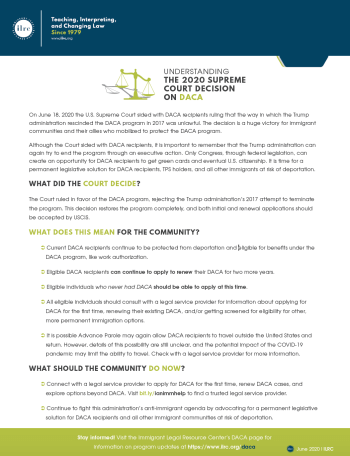
On June 18, 2020 the U.S. Supreme Court sided with DACA recipients ruling that the way in which the Trump administration rescinded the DACA program in 2017 was unlawful. The decision is a huge victory for immigrant communities and their allies who mobilized to protect the DACA program.
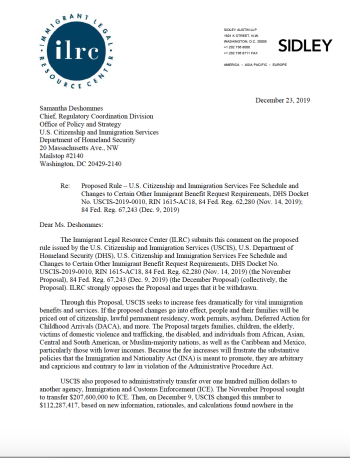
On December 23, 2019, ILRC submitted a comment in opposition of the Department of Homeland Security’s notice of proposed rulemaking titled, “U.S. Citizenship and Immigration Services Fee Schedule and Changes to Certain Other Immigration Benefit Request Requirements,” published in the Federal Register on November 14, 2019, with supplemental information published on December 9, 2019. ILRC submitted supplemental comments in early 2020.
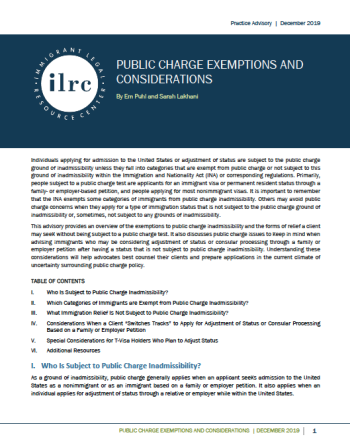
It is important to remember that immigration law and regulations exempt some categories of immigrants from public charge inadmissibility and provide many types of immigration status that are not subject to the public charge ground of inadmissibility. This advisory provides an overview of the exemptions to public charge inadmissibility and the forms of relief a client may seek without being subject to a public charge test. It also discusses public charge issues to keep in mind when advising immigrants who may be considering adjustment of status or consular processing through a family or employer petition after having a status that is not subject to public charge inadmissibility. Understanding these considerations will help advocates best counsel their clients and prepare applications in the current climate of uncertainty surrounding public charge policy.
In certain immigration cases, you may want to submit a Freedom of Information Act (FOIA) request to the U.S. Department of State (DOS), such as to try to find information about previous visa applications and passport records. This Practice Advisory will go over the DOS FOIA process in detail and provide practice tips for obtaining personal records from them, including best practices.
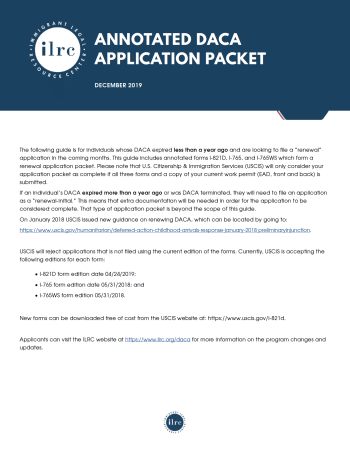
This guide is for individuals whose DACA expired after September 5, 2016 and are looking to file a “renewal” application in the coming months. The guide includes annotated forms I-821D, I-765 and I-765ws which form a renewal application packet. If an individual’s DACA expired on or before September 5, 2016 or was DACA terminated, they will need to file an application as a “renewal-initial.” This means that extra documentation will be needed in order for the application to be considered complete. That type of application packet is beyond the scope of this guide.
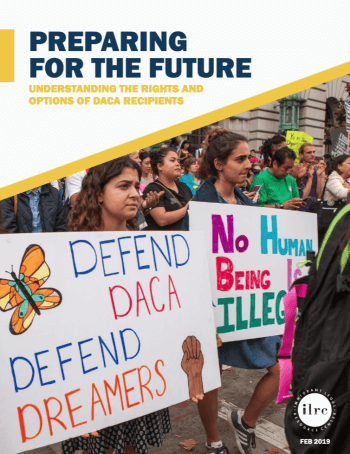
The Deferred Action for Childhood Arrivals (DACA) program has faced many threats and experienced significant changes since it began in 2012. This toolkit was created to help inform DACA recipients about their rights as well as how other community members can support DACA recipients during these challenging times.