Areas of Expertise

The Immigrant Legal Resource Center (ILRC) immigration attorneys’ expertise focuses on family-based immigration, humanitarian relief, naturalization and citizenship, immigration enforcement, and removal defense.

Since 1979 we have helped expand the immigration expertise of attorneys, nonprofit staff, criminal defenders, and others assisting immigrant clients.

In addition to authoring the ILRC’s practice manuals, our expert attorneys have been published by Continuing Education of the Bar (CEB), American Immigration Lawyers Association (AILA), ILW.com, Huffington Post, Sargent Shriver National Center on Poverty Law, Center for Law and Social Policy, The Hill, LexisNexis Emerging Issues, and Fox News Latino.
 
We have also provided training to National Council of Juvenile and Family Court Judges, National Association of Criminal Defense Lawyers, American Immigration Lawyers Association (AILA), American Bar Association Commission on Immigration, Federal Bar Association, The State Bar of California, Legal Aid Association of California, Judicial Council of California and more.
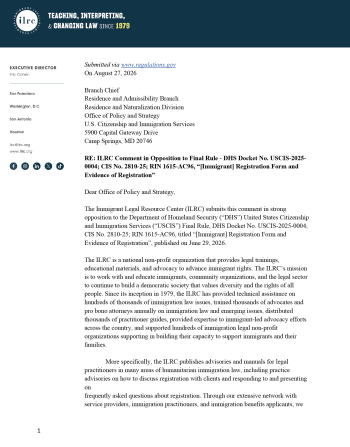
On June 29, 2026, the Immigrant Legal Resource Center (ILRC) submitted comments urging USCIS to withdraw its proposed revisions to Form N-648, the Medical Certification for Disability Exceptions used by naturalization applicants seeking a waiver of the English and civics requirements based on disability. ILRC commented that the proposed revisions unlawfully impose new eligibility standards that are not authorized by the Immigration and Nationality Act, federal regulations, or USCIS's own Policy Manual.
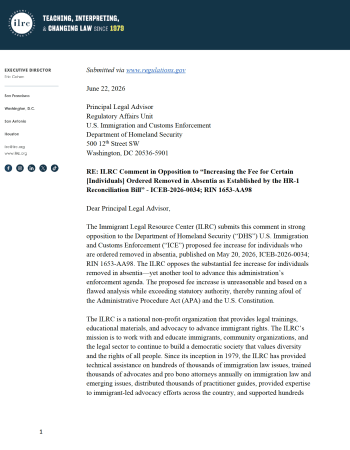
The Immigrant Legal Resource Center (ILRC) submitted comments opposing the Department of Homeland Security's proposed rule to increase the filing fee for Form I-246, the Application for a Stay of Deportation or Removal, from $155 to $755. The comment provides that the proposed 387% fee increase is arbitrary and capricious under the Administrative Procedure Act because DHS fails to provide a reasoned justification for the increase or adequately consider its devastating impact on immigrants seeking protection from deportation.
For more than two years, advocates have decried Texas SB 4 (2023), a law that creates new state offenses of illegal entry, reentry, and failure to comply with a state removal order. As of May 29, 2026, the law is fully in effect, bringing all Texans and those suspected of being undocumented under the permanent threat of immediate detention and deportation by the state, should they be suspected of violating the law. Texas SB 4 represents an unheard-of state usurpation of federal law, violating constitutional principles and norms that govern how states interact with the federal government. This policy brief breaks down the law and shares how communities can best prepare for a world with Texas SB 4 on the books.
On Friday, May 26, 2026, the United States Citizenship and Immigration Services (USCIS) office released a notice for clients of former immigration attorney Alexandra Lozano. USCIS urges applicants represented by former attorney Alexandra Lozano, who marketed herself as “la milagrosa” (miracle worker), to update their mailing address and informs them that they can withdraw their application or petition by submittiOn Friday, May 26, 2026, the United States Citizenship and Immigration Services (USCIS) office released a notice for clients of former immigration attorney Alexandra Lozano. USCIS urges applicants represented by former attorney Alexandra Lozano, who marketed herself as “la milagrosa” (miracle worker), to update their mailing address and informs them that they can withdraw their application or petition by submitting a written request. USCIS, however, fails to explain the consequences of withdrawing an application or petition. In this community alert, we will address some frequently asked questions. ng a written request. USCIS, however, fails to explain the consequences of withdrawing an application or petition. In this community alert, we will address some frequently asked questions.
As 287(g) agreements rapidly expand across the country, more law enforcement agencies are being radically transformed into a sweeping immigration enforcement machine. Police agencies are choosing to enter into the most expansive and harmful 287(g) agreement available, the Task Force Model. This policy brief provides a breakdown of the Task Force Model and how it provides carte blanche for rampant racial profiling, unbridled civil rights abuses, and little to no federal oversight.
Shortly after the Trump administration took office in 2025, the government began its directives to ramp up immigration raids and public operations across the country. These large-scale campaigns of mass deportation further exploded after the so-called “One Big Beautiful Bill Act”, or H.R. 1, ballooned the DHS budget to an astronomical $170,700,000,000 of taxpayer dollars over the next four years; creating a new annual ICE budget that is larger than the entire defense budgets of Italy, the Netherlands, Brazil, and Switzerland.
The Trafficking Survivors Relief Act (TSRA) was passed on January 23, 2026, and provides new federal post-conviction relief options for those convicted of certain federal offenses that were committed as a direct result of having been a victim of human trafficking. This practice alert discusses the new law and potential benefits for noncitizen defendants.
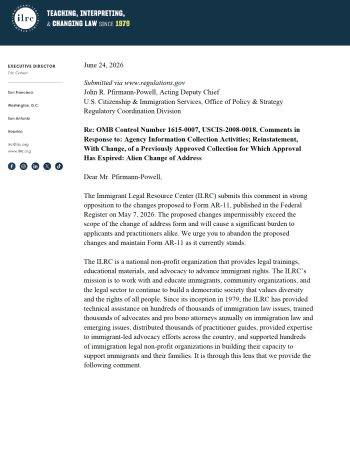
This explainer provides information and context for the Department of Homeland Security’s proposed rule seeking to change Form AR-11, Change of Address. DHS proposes to add questions seeking information about a person’s employment or current schooling and whether they have received any means-tested benefit. The proposed form change is over-broad and will result in confusion for applicants who are required to update the government about their address changes. This rule is proposed and is NOT in effect yet.
USCIS has exclusive jurisdiction to adjudicate certain applications for immigration relief that protect survivors of crime and other forms of abuse. Many people who are in active removal proceedings are eligible for one or more of these forms of relief. In the past, it was often possible to postpone or terminate removal proceedings to pursue such relief at USCIS. However, current policies at the Executive Office for Immigration Review (EOIR) and increasingly negative caselaw from the Board of Immigration Appeals (BIA) have made navigating removal proceedings for these applicants extremely challenging. The challenges are exacerbated due to visa backlogs and USCIS adjudication delays for these forms of relief. This advisory provides an overview of affirmative relief for immigrant survivors, summarize recent BIA cases on point, and offer practice tips for protecting against removal.
In this community explainer we will discuss some questions that have been raised since the publication of the memo as well as practical considerations for family-based applicants for adjustment of status.
On April 23, 2026, the Immigrant Legal Resource Center (ILRC) submitted a comment opposing a proposed rule that would significantly limit work authorization for asylum seekers. The ILRC comments that the rule would drastically restrict access to work permits and make it nearly impossible for many asylum seekers to survive while their cases are pending. It highlights that the proposal would lengthen wait times, add new eligibility barriers, and allow broad discretionary denials, effectively undermining the asylum system and deterring legitimate applicants. The ILRC contends the rule would cause severe economic, social, and health harms, including lost wages, increased exploitation, family instability, and reduced access to legal representation and basic services, while also disproportionately harming immigrants of color. Additionally, the ILRC criticizes related form changes as unlawful and overly burdensome, concluding that the proposal lacks evidence to support its stated goals and urging DHS and USCIS to withdraw it entirely.
On April 10, 2026, USCIS issued a new memo again terminating the SIJS deferred action (DA) policy (“April 10th Memo”). Under the April 10th Memo, USCIS will no longer automatically consider granting DA to young people granted SIJS. This termination memo does not, however, go into effect until May 10, 2026, and only applies to SIJS petitions filed on or after that date. This practice alert discusses what the April 10th Memo means for SIJS petitions and SIJS DA renewals filed prior to and on or after May 10, 2026, including helpful charts.
This practice alert, created in partnership with the End SIJS Backlog Coalition, explores a largely un-tested legal argument that young people with approved SIJS petitions can use the SIJS-specific adjustment provisions at INA § 245(h) to satisfy the “inspected and admitted or paroled” requirement to adjust using some other non-SIJS immigrant petition (for example, a spousal petition).